
Assertiveness Techniques
August 17, 2026Understanding Post Traumatic Stress Disorder
August 17, 2026“Boundaries define us. They define what is me and what is not me. A boundary shows me where I end and someone else begins, leading me to a sense of ownership. Knowing what I am to own and take responsibility for gives me freedom”
– HENRY CLOUD
DEFINITION
What is a boundary?
- A BOUNDARY is a definite place where your responsibility ends and another person’s begins. It stops you from doing things for others that they should do for themselves.
- A BOUNDARY also prevents you from rescuing someone from consequences of their destructive behaviour that they need to experience in order to grow.
- Boundaries are norms, rules, or codes that characterise an individual’s space or environment and his sense of safety or security. Healthy boundaries provide a nurturing and safe physical, emotional, sexual and spiritual environment for individuals.
PERSONAL BOUNDARIES
Personal boundaries are the limits and rules we set for ourselves within relationships.
- A person with healthy boundaries can say “no” to others when they want to, but they are also comfortable opening themselves up to intimacy and close relationships.
- A person who always keeps others at a distance (whether emotionally, physically, or otherwise) is said to have rigid boundaries.
- Alternatively, someone who tends to get too involved with others has porous boundaries.
TYPES OF PERSONAL BOUNDARIES
- Physical boundaries – Refer to personal space and physical touch. Healthy physical boundaries include an awareness of what’s appropriate, and what’s not, in various settings and types of relationships (hug, shake hands, or kiss?). Physical boundaries may be violated if someone touches you when you don’t want them to, or when they invade your personal space (for example, rummaging through your bedroom).
- Intellectual boundaries – Refers to thoughts and ideas. Healthy intellectual boundaries include respect for others’ ideas, and an awareness of appropriate discussion (should we talk about the weather, or politics?). Intellectual boundaries are violated when someone dismisses or belittles another person’s thoughts or ideas.
- Emotional boundaries -Refers to a person’s feelings. Healthy emotional boundaries include limitations on when to share, and when not to share, personal information. For example, gradually sharing personal information during the development of a relationship, as opposed to revealing everything to everyone. Emotional boundaries are violated when someone criticizes, or invalidates another person’s feelings.
How to Set Personal Boundaries
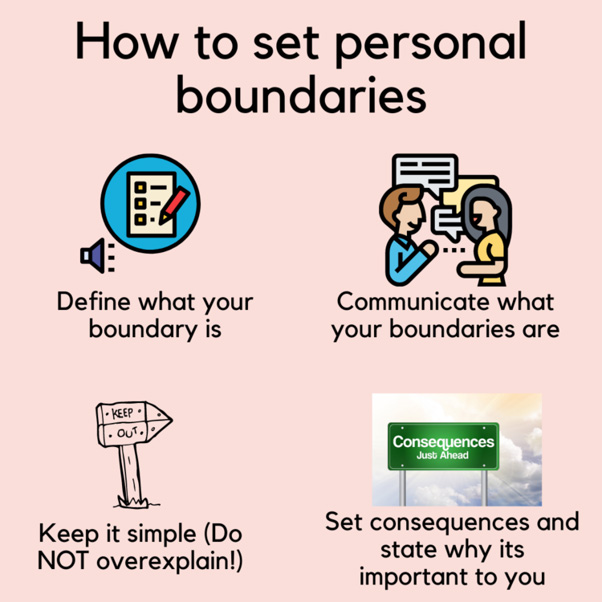
HOW DO WE ESTABLISH HEALTHY PERSONAL BOUNDARIES?
- Know that you have a right to personal boundaries. You not only have the right, but you must take responsibility for how you allow others to treat you. Your boundaries act as filters permitting what is acceptable in your life and what is not. If you don’t have boundaries that protect and define you, as in a strong sense of identity, you tend to derive your sense of worth from others. Identify the actions and behaviors that you find unacceptable. Let others know when they’ve crossed the line, acted inappropriately, or disrespected you in any way. Do not be afraid to tell others when you need emotional and physical space.
- Trust and believe in yourself. You know what you need, want, and value. Don’t let anyone else make the decisions for you. Healthy boundaries make it possible for you to respect your strengths, abilities and individuality as well as those of others.
PROFESSIONAL BOUNDARIES
Professional boundaries are the legal, ethical and organisational frameworks that protect both clients and employees, or workers, from physical and emotional harm, and help to maintain a safe working environment.
- A sense of professional identity and self definition that has consistency and cohesion over time.
- The framework within which the worker-client relationship occurs.
- The line between the self of client and self of worker
- Prescribes a system of limits and expectations
WHY IS IT IMPORTANT AT WORK
- Provides safety for both the worker and the client
- Reduces client/worker anxiety as rules and roles are clear
- Increases well-being of the worker
- Provides a therapeutic environment underpinned by mutual respect.
CONSEQUENCES DUE TO LACK OF BOUNDARIES
- Leads to potentially unsafe practice
- Increases client/worker stress
- Undermines the therapeutic relationship
- Can compound clients difficulties
THE ROLE OF THE MANAGER AND/OR SUPERVISOR
- Primary responsibility is to ensure that the worker or supervisee maintains appropriate professional boundaries in their work
- Understanding how boundaries become compromised
- Ability to provide emotional containment to the worker when work is emotionally demanding
- Willingness to challenge/address boundary issues
MINIMIZING RISK OF EXPLOITATION AND BOUNDARY CROSSING: A CHECKLIST FOR MANAGERS
- A clear understanding of what is ethical and professional behaviour
- Awareness of organisational factors that can compromise professional boundaries
- Maintain supervision or consultation relationships (isolation is often a major factor in boundary violations)
- Be alert to potential /actual conflicts of interest
- Understand and be willing to address the emotional impact on workers when working with clients in need.
BENEFITS OF BOUNDARIES
- Promotes autonomy
- Wards of burnout
- Improved emotional health
- Improved relationships
- Respect for self and others
- Improved self-care capabilities
- Decreased stress
- Clear expectations for others
HOW TO IMPLEMENT BOUNDARIES
HOW TO SET HEALTHY BOUNDARIES
Boundaries are talked about all the time in the context of human relationships: but what are boundaries, exactly? Some people grew up without them, and others might have learned an unhealthy model of what boundaries look like. It’s very important to understand what boundaries are, how they work, and why they’re crucial not just in your relationships, but in work, family, and other realms of life.
This is a guide to boundaries: what healthy boundaries are, what potential unhealthy boundaries can be, and how to apply them across many different aspects of life.
What are Healthy Boundaries?
Boundaries are parameters you create based on how you would like to be treated. Think of them as invisible lines that define what is and isn’t acceptable treatment or behavior. When communicated, they help those around you know how you would like to be treated and what your needs are around any given interaction.
Boundaries are also your own to make: only you can decide what is and is not acceptable treatment, and how you will respond if your boundaries are crossed. Because of that, they can sometimes be really difficult to conceive , particularly for those who might have grown up in a household without boundaries or where boundaries were not respected.
TYPES OF HEALTHY BOUNDARIES
While most commonly known in the context of interpersonal relationships, healthy boundaries can come in all types of forms. Here are five common types of healthy boundaries, with examples:
- PHYSICAL BOUNDARIES
These are boundaries that involve your physical well being. An example might be asking not to be hugged or touched while anxious, keeping six feet of distance while indoors, or turning down a massage from a friend or loved one.
- SEXUAL BOUNDARIES
These are boundaries within the context of a sexual relationship. What do you enjoy or not enjoy while engaging in sexual relations? Starting with overall consent to sexual intercourse, sexual boundaries can define where you don’t want to be touched, what actions you’re willing to do (or not), or even regarding things like aftercare or conversation during intercourse.
- EMOTIONAL BOUNDARIES
Emotional boundaries are more difficult to define as they’re not quite so black-and-white as physical or sexual boundaries. Examples of an emotional boundary might include “please don’t speak to me in this way,” or deciding that you’re not comfortable hearing someone else’s trauma or input at this time. These are designed to protect your emotional health. Often times a potential consequence might be to walk away or disengage- challenging, but better than being subjected to unpleasant emotional experiences.
- FINANCIAL BOUNDARIES
Financial boundaries are most often boundaries that you set with yourself to ensure that you live within your means. This might look like only allocating $100 to “fun” experiences per month, or it might look like only shopping for clothing that is on sale. With regards to other people, it might look like turning down a dinner at an expensive restaurant because it’s not within your means, or, if you’re sharing finances with someone else, establishing boundaries on individual budgets for the betterment of both of you.
- TIME BOUNDARIES
Time boundaries honor that your time is valuable; they often involve deciding when and when not to wait for someone. An example of this might be telling a friend you’ll meet with them, but they can’t be more than 15 minutes late. Or it might mean postponing date night until you get a necessary work project done. These showcase that you honor your own time.
HEALTHY VS UNHEALTHY BOUNDARIES
It’s important to recognize what is a healthy boundary versus what an unhealthy boundary looks like. While they can be very nuanced, below are some examples of each type of boundary to help you understand the difference when setting your own boundaries effectively.
Examples of Healthy Boundaries
Healthy boundaries and consequences are extremely important. One way to know that a boundary is healthy is that it is easy for you to define, communicate, and enforce in a way that respects the autonomy of the other person as well. For example, if your mother-in-law shows up to your home unexpectedly with frequency, a boundary asking them to call beforehand or else you will not answer the door respects their autonomy while preserves you from a surprise visit.
Examples of Unhealthy Boundaries
Unhealthy boundaries, meanwhile, do not set you up for success either in the boundary itself or in the consequence. For example, never saying “no” to a significant other is a very unhealthy boundary, as it communicates that they can treat you however they please. Contrarily, cutting off all contact with a friend who routinely shows up late even when you ask them to be on time is a disproportionate response to them violating your boundary. The important balance here is empathy for the other while maintaining a commitment to your own health and safety.
Unhealthy boundaries can also force isolation or create potentially dangerous or abusive situations.
When Do Unhealthy Boundaries Turn Into Abuse
Unhealthy boundaries can open the door to jeopardizing your well being. Not saying “no” or being unwilling to stand up for yourself can turn into abuse in certain circumstances. If you are unwilling or don’t know how to create boundaries in a relationship, this can be dangerous: abusers often prey on those with poor boundary skills.
HOW TO SET HEALTHY BOUNDARIES
Now that we know what boundaries are, it’s important to also know how to set healthy boundaries in all aspects of your life. It can be very difficult to do so, or even feel wrong when you first begin to stand up for yourself, but ultimately you are the only person you have to advocate for yourself.
SETTING BOUNDARIES IN RELATIONSHIPS
Setting boundaries in relationships is necessary for the well being of yourself and your spouse. It’s best to talk to them at a time when you’re both present and able to converse, and it’s important also to demonstrate a clear consequence: for example, if your spouse struggles with coming home from work on time, let them know you will eat dinner without them unless they call ahead. Again, all of these boundaries are placed with self-love and love for the other- there’s no need to be punitive. Even in more extreme cases where a spouse might struggle with substance abuse, a loving boundary that protects you is important: when they’re sober, let them know that you won’t spend time with them if they’re visibly intoxicated (or whatever you’re comfortable with).
SETTING BOUNDARIES WITH FAMILY
Setting boundaries with family, especially your parents, can also feel very difficult. No one’s family is perfect, and sometimes your family might harm you emotionally without realizing it. If, for example, your mother has a habit of mentioning her diet or weight frequently and this makes you uncomfortable, you can say “I’d prefer if we don’t talk about your weight loss. If you bring it up, I will change the subject or we will speak another time.” This again honors the autonomy of the other while honoring your own needs and comforts.
SETTING BOUNDARIES WITH FRIENDS
Setting boundaries with friends can really preserve the longevity of your relationship with them. This can range from how often you see your friends to how they treat you and will help weed out people who might not be good friends for you. If a friend is routinely flaky in trying to spend time together, try setting a boundary: “I understand that things come up last minute, but I’d rather we see each other less frequently if you continue to cancel our plans last minute.” This honors your time and emotions while still creating space to foster friendship.
SETTING BOUNDARIES AT WORK
Work boundaries, particularly in industries that have a high rate of burnout, can be the difference between good and bad mental health. Whether it’s setting boundaries around when you check or respond to emails, when you are available via Slack, or even what your work hours are, ensuring you have guardrails against overwork is very important. Similarly, if you have a supervisor who tends to ask you to do things last minute, creating a space to ask for a reasonable timeline will make your quality of life at work all the better.
HOW TO SET BOUNDARIES
Identify or define the desired boundary
Communicate what is needed – Don’t overexplain – state why it is important
Examples :
- Parent Child – parent may ask children to not enter the bedroom without knocking – privacy
- Child – may ask parent to not read their diary
- Romantic relationship – asking for one night out per week to spend time by him/herself and not to see one another each day; asking partner to assist with the baby so that she can take care of herself
- Friendship – someone is in the middle of studying and her friend comes to visit unannounced – she may ask her to not stay too long.
- Counsellor – respond to client emails during office hours
- Teacher and Student – teacher may set healthy boundaries by choosing to keep their personal lives separate from their professional lives by not telling their students too much about their private lives
MOST IMPORTANT RULE FOR BOUNDARIES
- CONSISTENCY
CONCLUSION
Boundaries are a way in which we can love ourselves while honoring the autonomy of those around us. They help us define exactly what we need to thrive on the day-to-day, and they help those around us understand what is and is not okay. While it can feel bad, strange, or even uncomfortable to set and define boundaries, particularly if it’s a new concept for you, it’s well worth the time.
Setting healthy boundaries is a crucial part of life and an important aspect of any self-care practice.
- Someone who’s not used to setting boundaries might feel guilty or selfish when they first start out, but setting boundaries is necessary for mental health and well-being.
- Appropriate boundaries can look very different depending on the setting, and it’s important to set them in all aspects of one’s life
- While setting boundaries is crucial, it is even more crucial to respect the boundaries that others have set for themselves.
“When we begin to set boundaries with people we love, a really hard thing happens: they hurt. They may feel a hole where you used to plug up their aloneness, their disorganization, or their financial irresponsibility. Whatever it is, they will feel a loss. If you love them, this will be difficult for you to watch. But when you are dealing with someone who is hurting, remember that your boundaries are both necessary for you and helpful for them. If you have been enabling them to be irresponsibly, your limit setting may nudge them toward responsibility.” Henry Cloud and John Townsend
REFERENCES
- Len Sperry, MD, PhD, Sex, Priestly Ministry, and the Church, 2003
- https://www.womenrisechicago.org/resources/how-to-set-healthy-boundaries
- chrome-extension://efaidnbmnnnibpcajpcglclefindmkaj/https://www.unisa.ac.za/static/corporate_web/Content/About/Service%20departments/DCCD/Documents/dccd_study_personalboundaries_unisa.pdf
- Doel, M., Allmark, P. J., Conway, P., Cowburn, M., Flynn, M., Nelson, and Tod, A. (2009). Professional boundaries: crossing a line or entering the shadows? British journal of social work, 40 (6), 1866-1889.
- Lord Nelson, L. G., Summers, J. A. and Turnbull, A. P. (2004), ‘Boundaries in ‘Family-professional relationships: Implications for Special Education’ in Remedial and Special Education, 25.3, 153-165.