
Boundaries
August 17, 2026ASSERTIVENESS
Definition: Assertiveness is when a person acts with self-confidence according to their own rights without infringing on the rights of the other person.
Continuum of assertiveness:
Passive behaviour |
Assertive behaviour |
Aggressive behaviour |
| Passive behaviour:
A lack of respect for their own rights |
Assertive behaviour:
Respect for their own, as well as others’ rights |
||
| Verbal communication:
Apologetic; sighing; unclear; vague; soft spoken; long rambling sentences; hesitant filled with pause; “maybe”, “sort of”; whining tone; overly soft, warm or polite; apologises inappropriately; self-dismissal or self-put downs “I’m useless”, “it’s not important”. |
Non-verbal communication:
Lack of eye contact; shrug of shoulder; covering mouth with hand; raising eyebrows in anticipation; crossing arms or turning sideways; jaw trembling; lip-biting; winking or laughing when expressing anger; little use of gestures; at times inappropriately close interpersonal space. |
Verbal communication:
Firm; fluent; relaxed; midrange tone; appropriate volume; steady pace; sincere; cooperative; distinction between fact and opinion; willing to explore other solutions. |
Non-verbal communication
Comfortable direct eye contact; erect; balanced open body stance; smiles when pleased; open hand movements; relaxed jaw; reflective listening. |
| Pay-offs:
Avoid conflict; familiar pattern of behaviour; approval of others; praised for being selfless/going the extra mile; less responsibility; protected by others; control of others by means of manipulation. |
Price:
Living an unlived life; lack of decision making; forfeits self in trying to become what others want; creating guilt for the other party in the relationship for always getting their way; self-sacrifice leads to resentment; inability to control emotions; extensive fault-finding; repressed hatred, anger and jealousy; growth is thwarted; unsatisfying relationships; others get irritated; low self-knowledge and self-esteem.
|
Pay-offs:
Improved self-confidence, self-esteem and self-respect; compromise and conflict resolution; growth and inner peace; healthy nourishing relationships; more comfortable with self and others; reduced fear and anxiety; making own decisions; living own life; knowing what you want; better self-knowledge and a healthier sense of responsibility. |
Price:
Pain associated with honesty and caring confrontation; being authentically yourself; may elicit conflict; being vulnerable in relationships; requires effective listening, planning, thinking before speaking/acting; re-appraisal of basic values; willpower required to overcome previous learned passive or aggressive behaviours. |
| Aggressive behaviour:
A lack of respect for others’ rights |
Passive aggressive behaviour: Indirect resistance to the demands of others and an avoidance of direct confrontation |
||
| Verbal communication:
Loud; sarcastic; rude demands; requests given as clear instructions; short statements; fluent speech with few hesitations; firm voice; emphasising blaming words; uses threats “you’d better watch out”, harsh tone; boastfulness; opinions stated as facts. |
Non-verbal communication
Direct body language and directedness, large, fast movements, often invading other’s personal space; staring (eye contact); pointing finger; clenched fist; large gestures; striding around impatiently; leaning forward or over a desk; upright posture; broad shoulders; fast paced walk; smiling may become sneering; jaw set firm; raised eyebrows to intimidate.
|
Verbal communication:
Indirect; emotionally loaded; sarcastic; jokingly serious; insinuating; lying; manipulative – uses guilt or sulking; chronic excuses; blaming others or situation for own feelings or behaviour; consciously deceiving; ambiguous. |
Non-verbal communication:
Shaking head; rolling eyes; pouting; shrugging shoulders; ‘w’-arms; unresponsive to other’s interaction especially confrontation; withholding kindness, love, or actions to punish; sabotaging efforts or relationships of others. |
| Pay-offs:
Secure wanted material needs and objects; gets what they want; capable of protecting self (at expense of others); less vulnerable; competitive; driven; makes decisions; has control over others; shapes own destiny. |
Price:
Elicit fear and conflict; loss of control; alienation; dehumanisation and ill-health; experiencing fear and feeling weak; low self-esteem; makes enemies; receives aggression; blames others; strikes back; lying; covering up; limited freedom; guilt feelings; burden of responsibility; distrust of others; few superficial relationships. |
Pay-offs:
Communicating message without direct confrontation; evades responsibility; sugar-coated hostility is socially acceptable; behaviours or comments are easily rationalised or justified; difficult to discipline or address as behaviour is difficult to pinpoint and anger is released; convenient – little forethought or effort needed. |
Price:
Others get annoyed or it elicits passive-aggressive behaviour from others; superficial or limited intimacy in relationships as people don’t always know where they really stand with you; lack of trust. |
ASSERTIVENESS TECHNIQUES
- EXPRESSING MY NEEDS/FEELINGS
- Prepare
- Self (deal with emotions prior to making the appointment. Factually look at situation, from different angles, also considering what it might be like to stand in the other person’s shoes.)
- Other person (make an appointment with the person, include the topic of discussion, be clear)
- Place (neutral place, consider privacy and distractions)
- Time (do not make appointment directly before and after lunch. Consider not exceeding 45 min.)
- Degree of information (Plan what you want to say, consider only stating facts that support topic of discussion.)
- Self-Disclosure
- Disclosing needs, feelings and expectations appropriately to a known person. Use structure in this order.
| 1) Situation | Factually explain your experience of the situation. At work it could include supporting documents such as a job description, policy or act. In a relational situation it could include past or current words or actions, boundaries agreed upon and previous agreements. |
| 2) Feeling | Voice feelings appropriately after dealing with the emotion and not while currently upset, or else you run the risk of venting. Do not use feelings as a disguise for expressing thoughts or opinions: “I feel that you don’t care how you treat me”, rather “I feel unloved”. |
| 3) Consequence | · Voice how the situation has influenced decisions, behaviours or outcomes in the situation or relationship: “Due to overtime work, we have less time together to be intimate or talk and it causes emotional distance in our relationship.”
· Or alternatively voice what the positive changes are that you are making to rectify an unhealthy situation: “Due to overtime work, I’ve realised that I need to have activities I can do on my own and not be so dependent on you for fun, thus I have decided to join a dance class.” |
- Active Listening
- Listening to understand, not just to reply. Be open to what message the other person is trying to convey. Making eye contact, nodding, not interrupting the other person.
- Be present in the conversation, be aware of their tone of voice as well as body language.
- Reflective Listening
- The listener restates the feeling and content of what the speaker has said to demonstrate understanding and acceptance.
- Examples: “I understand …, is what you meant?” or “I hear you say …, is that correct?”
- Explore possible solutions
- Request changes in behaviour, reactions and words. Ask the other person for their view on the situation and changes they would like to request. Be willing to explore changes or adaptations that you can make.
- Set boundaries
- Personal boundaries are guidelines, rules or limits that a person creates to identify for themselves what are reasonable, safe and permissible ways for other people to behave towards him or her and how they will respond when someone steps past those limits. It is therefore, not trying to control or change another person, but knowing what your response would be to continuous unhealthy or abusive behaviours.
- Compromise
- Reaching an acceptable agreement for all parties involved that protects and supports both parties as opposed to compromising values of one party.
- Conclude
- Summarise the discussion and any decisions made, or boundaries or requests agreed upon. Thank the person for their time and participation in discussion.
*Time Out:
This involves temporarily removing one’s self from an argument that has become unproductive or where one/both parties have become aggressive. It is important in the time out to:
- Deal with the emotion at hand, by identifying the trigger as well as supporting facts. Try and identify own possible misinterpretations, biases or assumptions. Do not use this as an avoidance technique. Voice when any why taking a time out, also reassure the other party that the discussion will resume after. Consider giving the person a time and place to meet again.
*Positive Assertion
Share positive sentiments about other people with them. Appreciating other people’s positive contribution to your life. Complimenting people sincerely without expecting anything in return. Do not use this as a manipulation tool.
- SAYING NO
| DIRECT NO | When someone asks you to do something you don’t want to. The aim is to say no without apologising. | ENQUIRING NO | This is not a definite no. It’s a way of opening the request to see if there is another way it could be met. |
| REASONED NO | In this technique you give a brief genuine reason for why you are saying no. | RAINCHECK NO | This is not a definite no. It’s a way of saying ‘no’ in the present moment but leaves room for saying ‘yes’ in the future. |
| REFLECTIVE NO | This technique involves acknowledging the content and feeling of the request, then adding your assertive refusal at the end. | BROKEN RECORD NO | Just repeat the simple statement of refusal repeatedly in a calm, yet firm manner. |
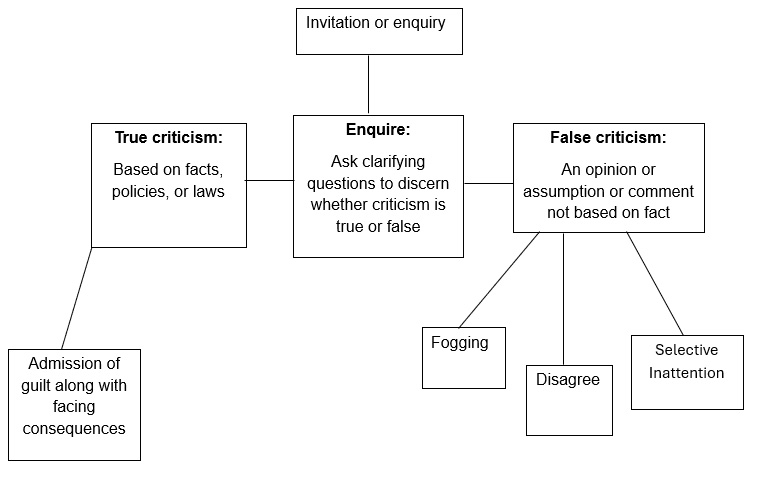
Invitation/Enquiry:
- This technique consists of requesting further, more specific criticism to discern what is meant by the critic. Instead of retaliating with criticism, ask clarifying questions. For example: “I hear that you are saying that the way I dress in inappropriate for work, in what way is it inappropriate?”
TRUE CRITICISM:
Admission of guilt:
It is important to accept your faults in a calm, controlled, self-assured manner and not in an apologetic or hostile manner. Other person: “The fact that the dress code stated you may not wear denim jeans and that’s what you are wearing.” You: “I realise that I am not meeting the requirements that are stated in the company policy.”
FALSE CRITICISM:
Disagree: Simply disagree with the criticism. It is important that you remain calm and maintain eye-contact. Where possible supply facts that validate your rejection of the criticism.
Fogging: Rather than arguing back, fogging aims to give a minimal, calm response using terms that are not defensive, while at the same time not agreeing to meet demands.
YOU CAN ‘FOG’ IN 3 WAYS:
- Agree in principle – Other person: “I have noticed that you put a company pen in your pocket earlier today, you are probably also taking from the petty case.”
You: “Yes, I do have a company pen in my pocket, which is wrong. I will return it today.”
- Agree in probability – Other person: “If you don’t study for this exam, you will fail and never succeed in life.” You: “Yes, not studying, might result in me not passing and this may affect my future.”
- Agree in part – Other person: “Your work has been really sloppy lately; the company has gone downhill since we hired you.” You: “I agree that this wasn’t my best work.”
Selective inattention: Listening to what the person is saying but choosing not to let the words affect you. Listening to what is being said as a while, but only responding to relevant information and addressing that.
Some tips:
- Do not deny the criticism (provides more ammunition)
- Do not become defensive (admitting the criticism may be justified)
- Do not counter-criticise (start an argument)
- Listen to exactly what the critic is saying – respond using the same words
- Respond only to what is said – not to what is being implied
- Remember that it is possible to value someone’s contribution without necessarily agreeing with it
- DEALING WITH DIFFERENT BEHAVIOUR
Remember: Assertiveness should also be encouraged in others so that they can communicate their ideas and emotions freely without feeling under pressure to say certain things.
- Passive Behaviour:
- Encourage their contribution through open questions, ask their opinion.
- Draw people into the discussion in group situations.
- Listen closely and show interest in what they are saying.
- Do not allow yourself to take responsibility for decisions that should be made jointly. Instead, support others to make their contribution to the discussion.
- Aggressive Behaviour
- Maintain self-control.
- Take time to think over issues before entering a discussion.
- Pausing and counting to 10 before responding.
- Avoid arguments and defensiveness. Find agreement with the other person, rather that focussing on disagreements.
RESOURCES: